
Jan 20, 2026
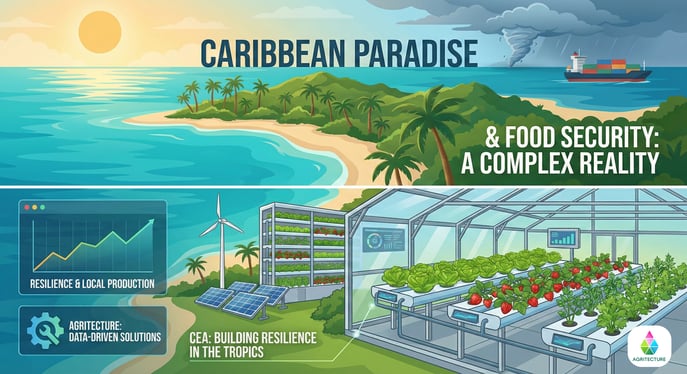
When the world thinks of the Caribbean, it pictures turquoise waters, white sands, and lush landscapes. But for those of us analyzing global food systems, the picture is more complex. Behind the paradise aesthetic lies a fragile food system heavily reliant on imports, vulnerable to supply chain shocks, and increasingly threatened by climate change.
At Agritecture, we believe the Caribbean represents one of the most compelling use cases for Controlled Environment Agriculture (CEA) in the world. However, the path to success here isn't about copy-pasting solutions from the Netherlands or New York; it requires a strategy deeply rooted in local climate realities and economic data.

Agriculture in the Caribbean: A shrinking but vital sector
Historically, agriculture dominated Caribbean economies. A 2019 FAO report notes that sugar and banana exports once accounted for the bulk of foreign revenue. After preferential trade deals with the European Union ended, many countries shifted to services and tourism. Today agriculture contributes less than 1 % of GDP in tourism‑driven islands such as Aruba and St Kitts, but it remains crucial in places like Haiti, Dominica, Guyana and Grenada where it accounts for 7–17 % of GDP and employs 10–25 % of the workforce. In Haiti nearly half of all workers still depend on farming.
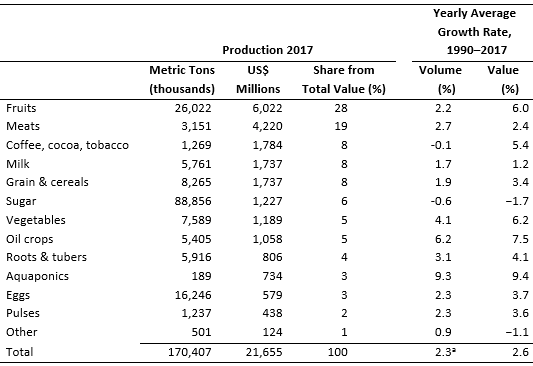
Crop mix is changing. A 2019 analysis in Choices Magazine reported that Caribbean and Central American countries produced roughly 170 million tonnes of raw food and fiber worth US$21.65 billion in 2017. Traditional crops such as sugar, bananas, coffee, cocoa and tobacco still occupy large acreage, but their share of value has stagnated. Tropical fruits like pineapple, mango, papaya, avocado and guava surged from 12 % to 28 % of total value over two decades. Pineapple production now surpasses bananas in value, with leaders including Costa Rica and the Dominican Republic. Vegetables (tomatoes, peppers, onions) and oil crops also expanded, reflecting a growing regional and international demand.
Food insecurity and rising prices
Despite this agricultural output, Caribbean populations remain highly food insecure. The World Food Programme’s 2025 Caribbean Food Security & Livelihoods Survey found that 3.2 million people (42 % of those surveyed) were food insecure, with progress stalled since the 2022 food‑price crisis. Ninety‑four percent of respondents reported higher food prices, 40 % experienced natural hazards like storms or droughts, and 30 % were skipping meals. To cope, households spent savings (65 %) or cut health and education expenses (48 %). Food inflation remained high in Jamaica (7.4 %), Guyana (5.6 %), St Vincent & the Grenadines (4.8 %) and Trinidad & Tobago (3.9 %) at the start of 2025. Many farmers also faced disruptions from high fertilizer and feed costs and from climate‑related shocks.
The Reality: A $6 Billion Problem
The Caribbean Community (CARICOM) currently imports approximately 80-90% of its food, with a regional food import bill exceeding $6 billion USD annually.
This dependency creates two critical vulnerabilities:
- Economic Leakage: Tourism dollars that should circulate locally instead leave the region to pay for imported lettuce from California or tomatoes from Mexico.
- Food Insecurity: As seen during recent global disruptions, when supply chains break, islands are the first to feel the shortage.
The "25 by 2025" initiative, CARICOM’s plan to reduce the food import bill by 25% by 2025, has set the stage for investment. But how do we get there?
Why Controlled Environment Agriculture (CEA)?
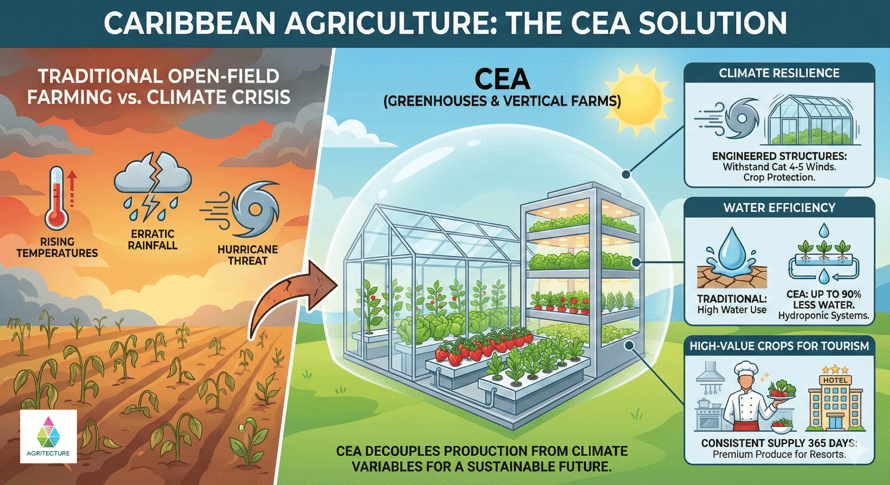
Traditional open-field farming in the Caribbean faces a brutal adversary: the climate crisis. Rising temperatures, erratic rainfall, and the existential threat of hurricanes make soil-based farming increasingly risky.
CEA (Greenhouses and Vertical Farms) offers a solution by decoupling production from these external variables.
The Potentials
- Climate Resilience: Engineered structures can be designed to withstand Category 4 and 5 hurricane winds, protecting the crop investment inside.
- Water Efficiency: Hydroponic systems use up to 90% less water than traditional farming—critical for water-scarce islands like Antigua or Barbados.
- High-Value Crops for Tourism: The hospitality sector demands consistency. High-tech farms can provide premium strawberries, leafy greens, and culinary herbs 365 days a year, matching the quality standards of 5-star resorts.
The Challenges: It’s Not Just About Growing
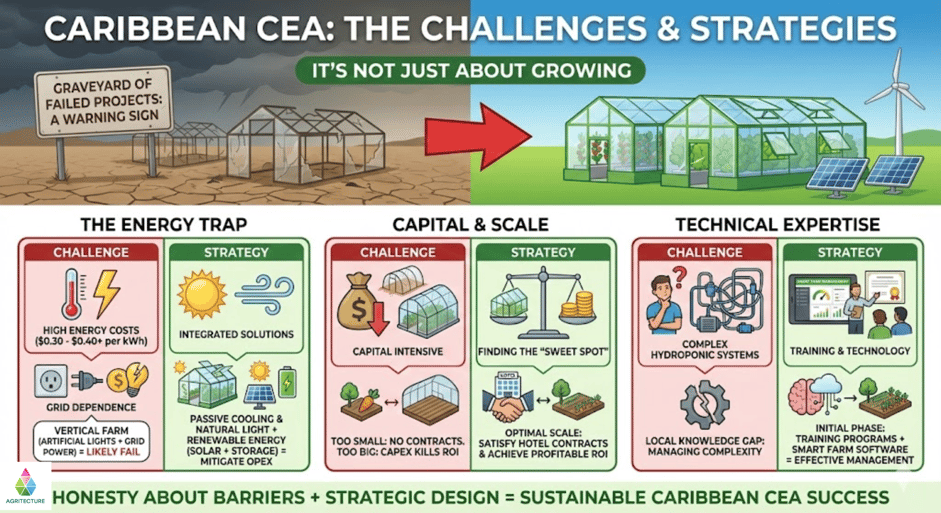
While the potential is clear, the graveyard of failed agricultural projects in the tropics is a warning sign. Moving forward requires honesty about the barriers.
1. The Energy Trap
Energy costs in the Caribbean are among the highest in the world, often ranging from $0.30 to $0.40+ per kWh, compared to ~$0.12 in the US.
- The Agritecture View: A vertical farm relying solely on artificial lights and grid power is likely to fail financially in this region. Successful designs must integrate passive cooling, natural light (greenhouses), and renewable energy (solar + storage) to mitigate OpEx.
2. Capital & Scale
CEA is capital intensive. Building a hurricane-resistant glasshouse costs significantly more than a hoop house.
- The Solution: Projects need to find the "sweet spot" of scale. Too small, and you can't satisfy a hotel contract; too big, and the CapEx kills your ROI.
3. Technical Expertise
There is a gap in local technical knowledge for managing complex hydroponic systems.
- The Strategy: Training programs and "smart" farm management software must be part of the initial design phase, not an afterthought.
Real-World Examples
We are already seeing the shift.
- Container Farms in Resorts: Hotels are deploying container farms on-site to grow fresh greens, eliminating food miles entirely.
- Disaster-Proof Greenhouses: New projects in Puerto Rico are utilizing retractable roof systems and reinforced steel structures designed specifically to survive storm seasons.
- Barbados’ solar‑powered container farm: A pioneering project in Barbados demonstrates how CEA can fit within island contexts. Indoor Vertical.Farm, in partnership with the Government of Barbados, installed an off‑grid container farm powered by a solar‑battery microgrid. The pilot uses aeroponic towers under LED lights and collects condensation to recycle water. Each container has its own HVAC, fertigation and irrigation systems, making it modular and scalable. Because Barbados imports about 85 % of its food, the government sees the project as a way to reduce dependence on imported produce while training farmers and students. The containers will be used to test crops under local conditions and to supply government departments and schools.
How Agritecture Moves You Forward
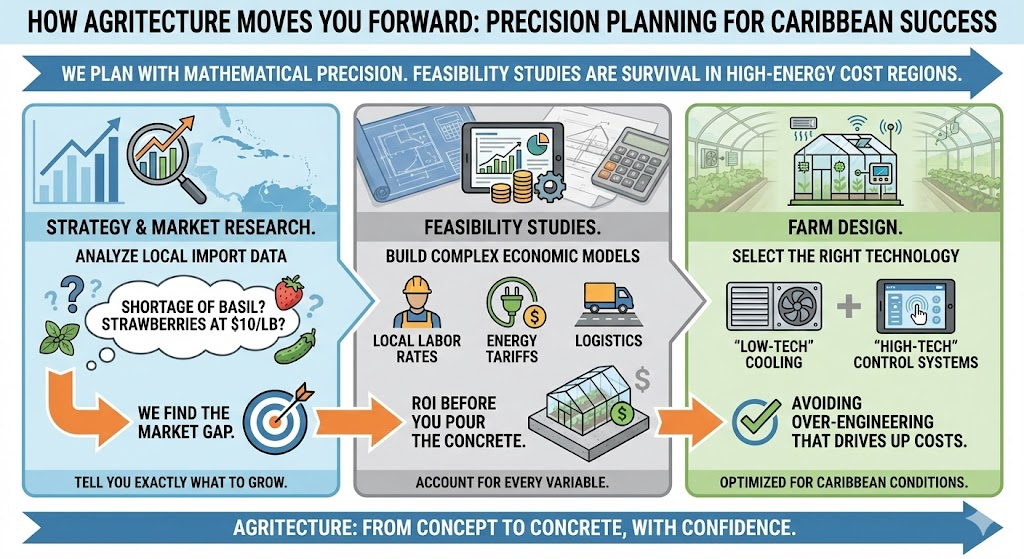
We don't just advocate for urban farming; we plan it with mathematical precision. In a region where electricity costs can break a business model, Feasibility Studies are not optional, they are survival.
We support Caribbean developers, investors, and governments through three phases:
- Strategy & Market Research: We analyze the local import data to tell you exactly what to grow. Is there a shortage of basil? Are strawberries importing at $10/lb? We find the market gap.
- Feasibility Studies: We build complex economic models that account for local labor rates, energy tariffs, and logistics. We tell you the ROI before you pour the concrete.
- Farm Design: We help select the right technology. In the Caribbean, this often means "low-tech" cooling combined with "high-tech" control systems, avoiding over-engineering that drives up costs.
Ready to Build Resilience?
The Caribbean has the sun, the market demand, and the urgent need. What it needs now is data-driven planning.
Whether you are a resort owner looking to secure your supply chain, or an investor eyeing the "25 by 2025" opportunity, Agritecture is ready to help you navigate the complexities of CEA in the tropics.
Contact us today to start your Feasibility Study: niko@agritecture.com
Conclusion
The Caribbean faces a dual challenge: producing enough nutritious food for its population while navigating limited land, climate risks and economic constraints. Controlled‑environment agriculture offers a promising tool to bolster food security by enabling year‑round, resource‑efficient production close to urban centers. Yet high start‑up and operating costs, limited crop varieties and energy reliance hinder widespread adoption. Successful examples in Barbados, Cuba, Puerto Rico and Trinidad show that with the right design, renewable energy integration and training, CEA can deliver fresh produce and reduce import dependence. Agritecture stands ready to help Caribbean governments, entrepreneurs and communities assess the feasibility of CEA systems, design resilient farms and build a sustainable food future.