
Sep 17, 2026
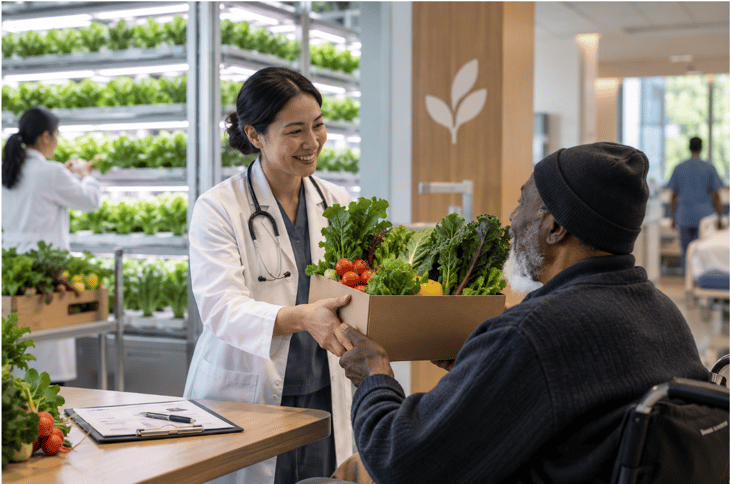
Source: Illustration generated with AI
By Henry Gordon-Smith and Victoria Moura
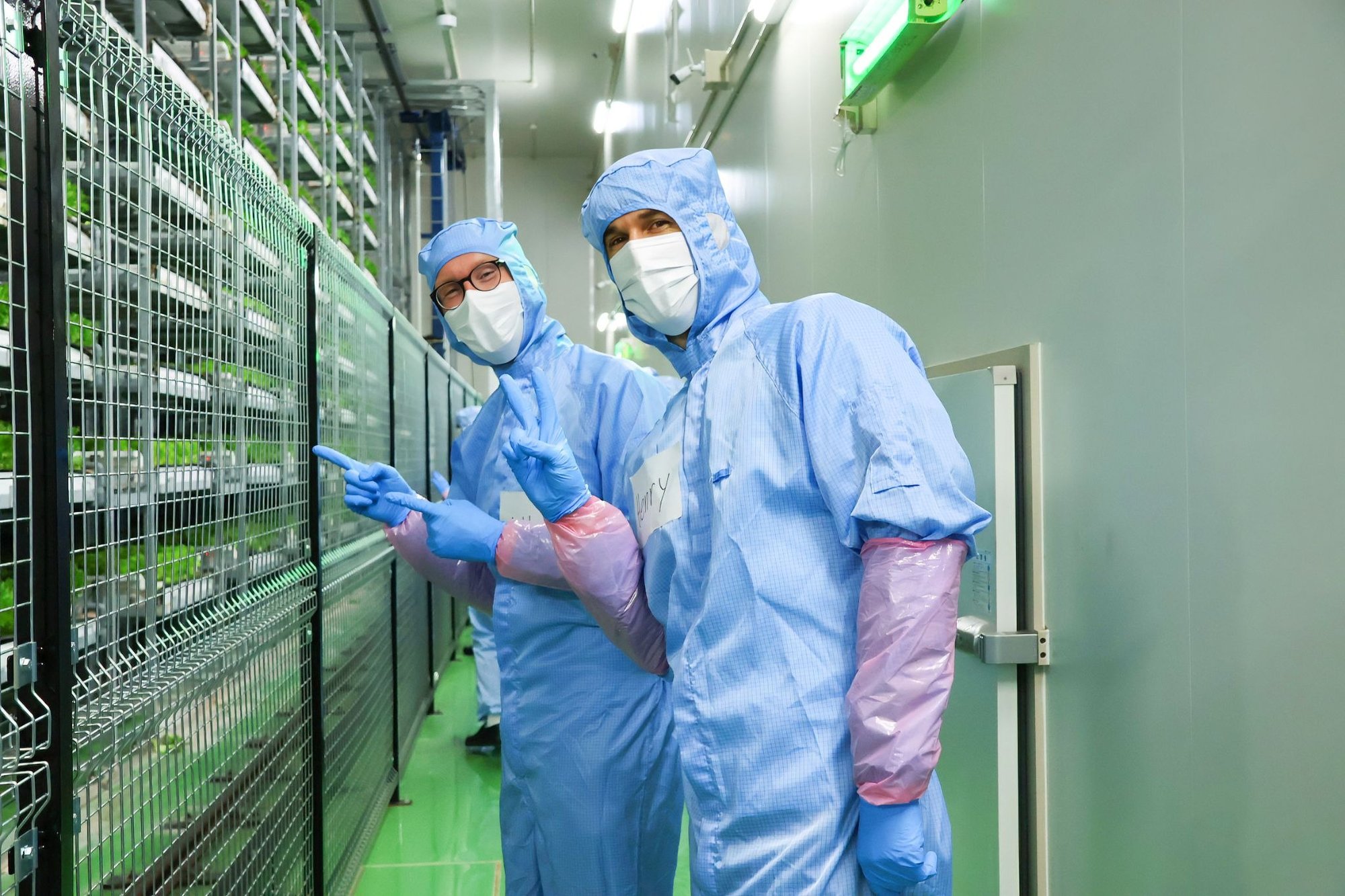
Plant factory, or PFAL (plant factory with artificial lighting), is the Japanese term for vertical farming: growing crops indoors under precisely managed light, temperature and nutrients. For a decade, plant factories have sold themselves on higher yields, less land, less water and proximity to the customer. At the Third JPFA International Symposium on Plant Factory in Kashiwa, Japan, hosted by the Japan Plant Factory Association, an NPO founded in 2010 that runs roughly 20 R&D projects out of Chiba University's Kashiwanoha campus, oncologist Katsuya Tsuchihara offered a case few others in the room were positioned to make: plant factories, he argued, belong in the blueprint for preventive health infrastructure, not just the food supply. For hospital systems, health real estate developers and the cities courting both, that reframing showcases an opportunity worth adding to a hospital campus site plan.
Key Points
What Japan's Plant Factories Are Actually Being Built For
Japan's Minister of Agriculture, Forestry and Fisheries, Chiba Prefecture's agriculture director and the Mayor of Kashiwa all opened the event in person, real weight for a sector this small: plant factories cover only about 19 hectares of floor space nationwide, against 37,894 hectares of greenhouses and other protected cultivation. That level of attention tracks with how much is riding on plant factories beyond their current footprint: food security on an import-dependent island, a shrinking farm labor force and an agtech export ambition have always mattered as much to the sector's case as yield does.
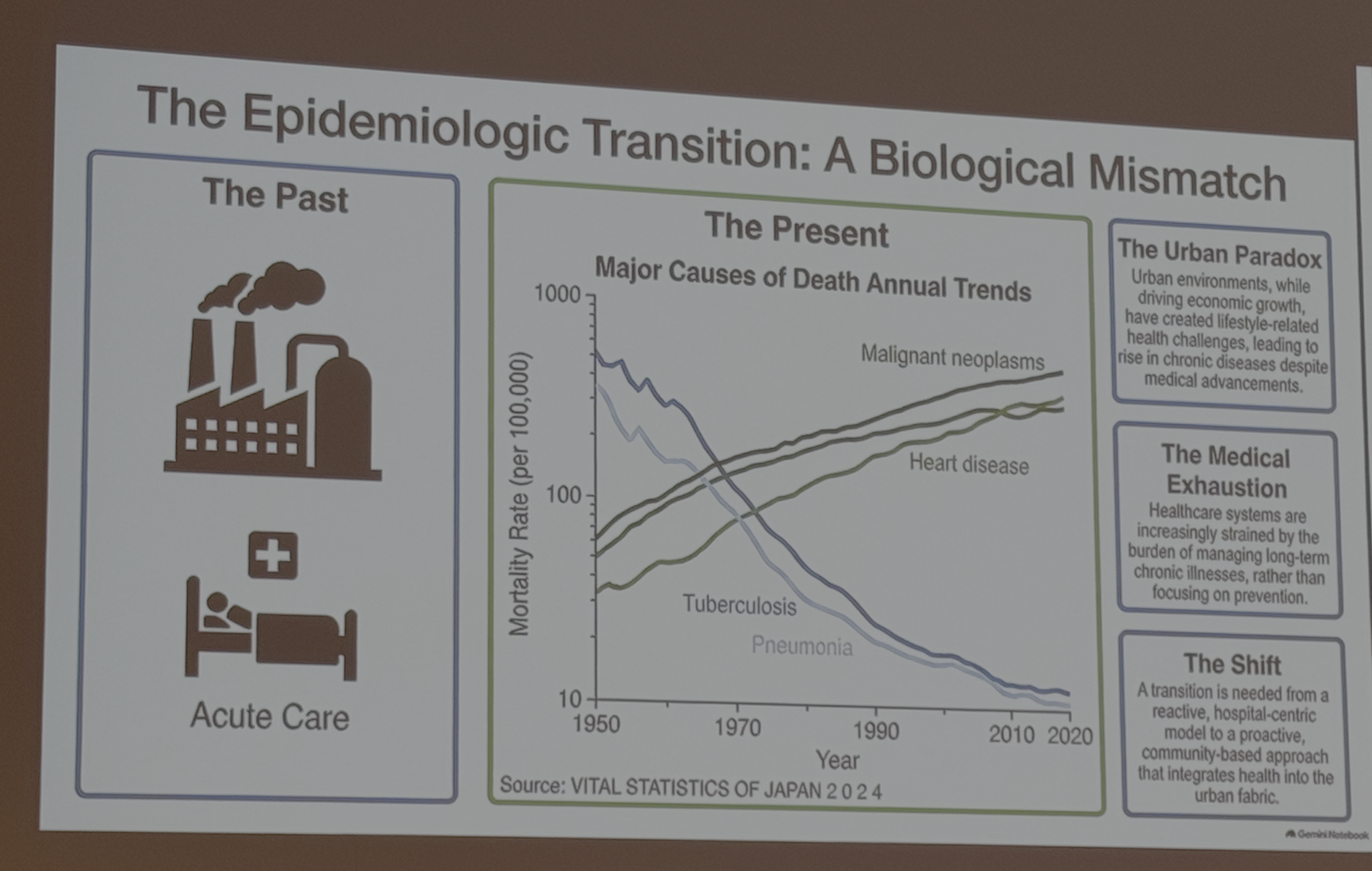
Tsuchihara, MD, PhD, a board member of the National Cancer Center Japan, put it plainly: "The future of health will not be created by medicine alone. It will be created by bringing medicine, agriculture, technology and urban design together". His argument rested on Japan's own mortality data. Tuberculosis and pneumonia deaths collapsed after 1950; cancer and heart disease climbed to take their place. A pill can knock out a single pathogen, which is why medicine handled the first problem outright. The second problem doesn't work that way. It accumulates over years of ordinary living: what someone eats, how much they move, how they sleep, exposures that quietly switch genes on and off through epigenetic mechanisms long before any of it reads as a diagnosis. There's no prescription for a lifetime of exposure. A city's food supply is one of the few things positioned to change that exposure instead.
Japan's plant factory sector wasn't built primarily to grow food more cheaply. Decades of R&D targeted a narrower problem: producing food when the arable land, water, or stable climate a crop needs aren't reliably available – the same logic behind Mirai Co.'s flagship facility, built on a site the 2011 Tohoku earthquake and tsunami devastated, to prove vegetables could grow there again. Tsuchihara built on that history, framing first-generation plant factories as answering one question: guaranteed supply regardless of outside conditions, before pitching a second generation. Because a controlled environment lets growers set light, temperature, humidity, and nutrient delivery independently of what's happening outside, the same control can be redirected from yield toward a target compound instead: a lettuce bred to carry extra antioxidants for someone in cancer treatment, a green engineered to carry less potassium for someone managing kidney disease. The output isn't just produce. It's a formulation, and that one design choice is what turns controlled environment agriculture into a precision nutrition tool, and precision nutrition into the supply line a Food is Medicine program needs to function as preventive healthcare rather than a wellness slogan.
That formulation is a shift in growing conditions, not genetic engineering, and it matters because how food is grown already changes what ends up on a plate. Field-grown produce depends on soil quality, which synthetic fertilizers and chemical pesticides can degrade over time, and on how long food sits between harvest and the table: leafy greens held at room temperature can lose roughly a fifth of their vitamin C within two days, and spinach can lose close to half its folate in four days. Indoor growing changes both: a plant factory sits inside or next to the city it feeds, so produce travels a few miles instead of a few thousand, cutting the shipping time that drains nutrients. Pests and weeds can't reach the crop, so plant factories need sharply less pesticide than open-field agriculture, and roots sitting directly in a nutrient solution instead of soil let hydroponic systems recirculate and reuse nutrients rather than lose them to runoff. Light is a third lever: research on lettuce shows raising light intensity increases antioxidant and vitamin content while lowering potassium, and specific light wavelengths can raise vitamin C by roughly a quarter. 
What the Model Actually Looks Like
Tsuchihara wasn't pitching a product. He was describing an infrastructure and the governance to run it. A grower cultivates a targeted crop to a clinical spec set with a hospital's nutrition team, and residents or patients consume it as daily food access, not a cafeteria donation. Testing on the people who eat it then measures what the crop did in their bodies, and that signal feeds back to adjust the next crop's light recipe, a genuine loop of food, health, and data. Every plant carries a digital record of its growing conditions, so a result can be traced to a specific recipe and repeated, and residents own their biological data on an opt-in basis.
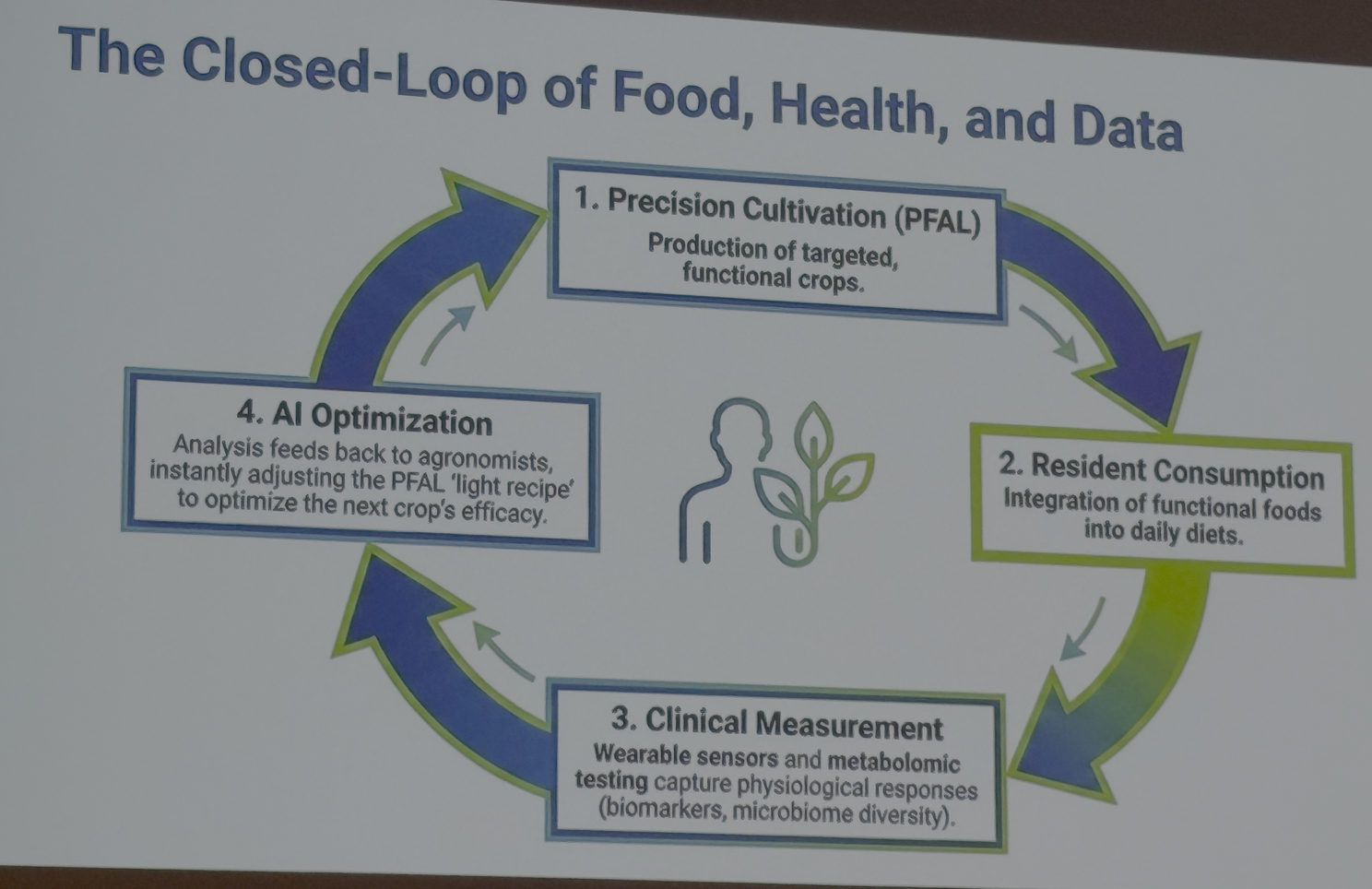
None of that runs on technology alone. It runs on a government, a university, a hospital system and a private developer sharing governance over one footprint, not just sitting near each other. That shared governance is the actual infrastructure, which is why the budget question below isn't optional.
The Seam a Hospital Budget Rarely Crosses
Here is the problem that can make this hard to build in other regions. Across OECD countries, an average of just 3% of total health expenditure goes to preventive care, with the rest spent treating people after they're already sick, according to OECD Health at a Glance 2025. That split is the architecture of a health system built for the acute-care era that Japan's own mortality data shows has already ended. Treat that 3% as a prompt, not just a complaint: what would it look like to question the system it describes, and build new infrastructure alongside the advances already reshaping medicine, genomics, AI diagnostics? A precision-agriculture supply line for precision nutrition, food grown to match a patient's clinical needs rather than a generic diet, is one answer, and it only works if the people who fund it, design it, and grow in it share a conversation.
That conversation rarely happens. Agronomists optimize a crop. Architects design a building envelope. Hospital administrators manage a food service contract that was signed for cost, not clinical outcome. Cardiologist Dariush Mozaffarian, who directs the Food is Medicine Institute at Tufts (a hub for the food is medicine movement that treats diet as a clinical intervention to be prescribed and paid for like a drug rather than suggested like a pamphlet), has put it bluntly: "Diet-related chronic diseases are the leading cause of human suffering and deaths worldwide. Poor diet alone is estimated to drive nearly three-quarters of new diabetes cases globally. We treat the consequences and barely fund the cause". The gap he's describing isn't a knowledge gap. It's a design and procurement gap, and closing it is a real estate and infrastructure decision as much as a medical one.
There's a financing argument buried in that quote too. Treating a symptom is usually a one-time transaction: a diagnosis, a prescription, a bill. Treating the cause is not. It takes a steady daily supply of the right food, not a single prescription, which is exactly why it has stayed underfunded: who would buy a treatment with a business model around paying for something that only works if it never stops? But that same requirement, consistency, is what a subscription is built on. A patient managing a chronic condition isn't buying a bag of lettuce once. They're buying a lower risk, delivered every day, and that is a customer worth building a recurring business around.
Another common barrier is procurement, the same disconnect Agritecture's own reporting on farm-to-table real estate has traced in hospitality and mixed-use projects. Hospitals sit inside long-term food service contracts with little room to shift sourcing toward a higher-quality, traceable, on-site supply, and school systems run into the same disconnect: whoever pays the cafeteria bill is never the one who benefits when a healthier lunch keeps a kid out of a doctor's office years later. Fixing that is a planning and financing problem, which is another reason why hospital administrators, real estate developers, and city economic development offices need a seat at the table.
The Evidence Is Starting to Show Up
Two Michigan hospital systems show what happens when this is embedded into operations, not run as a pilot. Saint Joseph Mercy Hospital changed its electronic medical record so doctors can refer food-insecure patients directly to the hospital's farm share from the exam room, generating $108,000 in revenue for 24 local partner farms in a single year, which represented two to 30% of their partner farms' sales. Henry Ford West Bloomfield Hospital built its own hydroponic greenhouse and chose soilless growing because it reduces microbial risk for immunocompromised patients, the same precision argument Tsuchihara made in Kashiwa, arrived at independently in Detroit. The model is still expanding: Hartford Hospital's Food4Health program, running a rooftop hydroponic farm, received a $250,000 Cigna Group Foundation grant in June 2026 to grow further.
Payment is starting to catch up too. Hawaii's Medicaid Section 1115 demonstration, approved by CMS on October 30, 2025, explicitly authorizes nutrition prescriptions, including fruit and vegetable prescriptions and healthy food vouchers, for eligible beneficiaries. That's a state-specific pathway, not a national CMS benefit, but it's the first documented mechanism letting a produce prescription – a doctor's order for fruits and vegetables filled like a prescription instead of suggested like advice – become a billable line item instead of a grant-funded pilot.
In terms of consumer demand, a survey of 121 Chiba residents, led by Beatrice Vivani of the University of Bologna with JPFA President Eri Hayashi, found plant factory awareness at 59% but habitual purchase at only 10%. The gap wasn't price. Safety and health topped purchase drivers at 24%, ahead of "no need to wash" at 20%, and just 12% said they would not pay more. People are responding to the health pitch more than they ever did to a lower price tag.
Smart Cities Are the Delivery Mechanism, Not Just the Backdrop
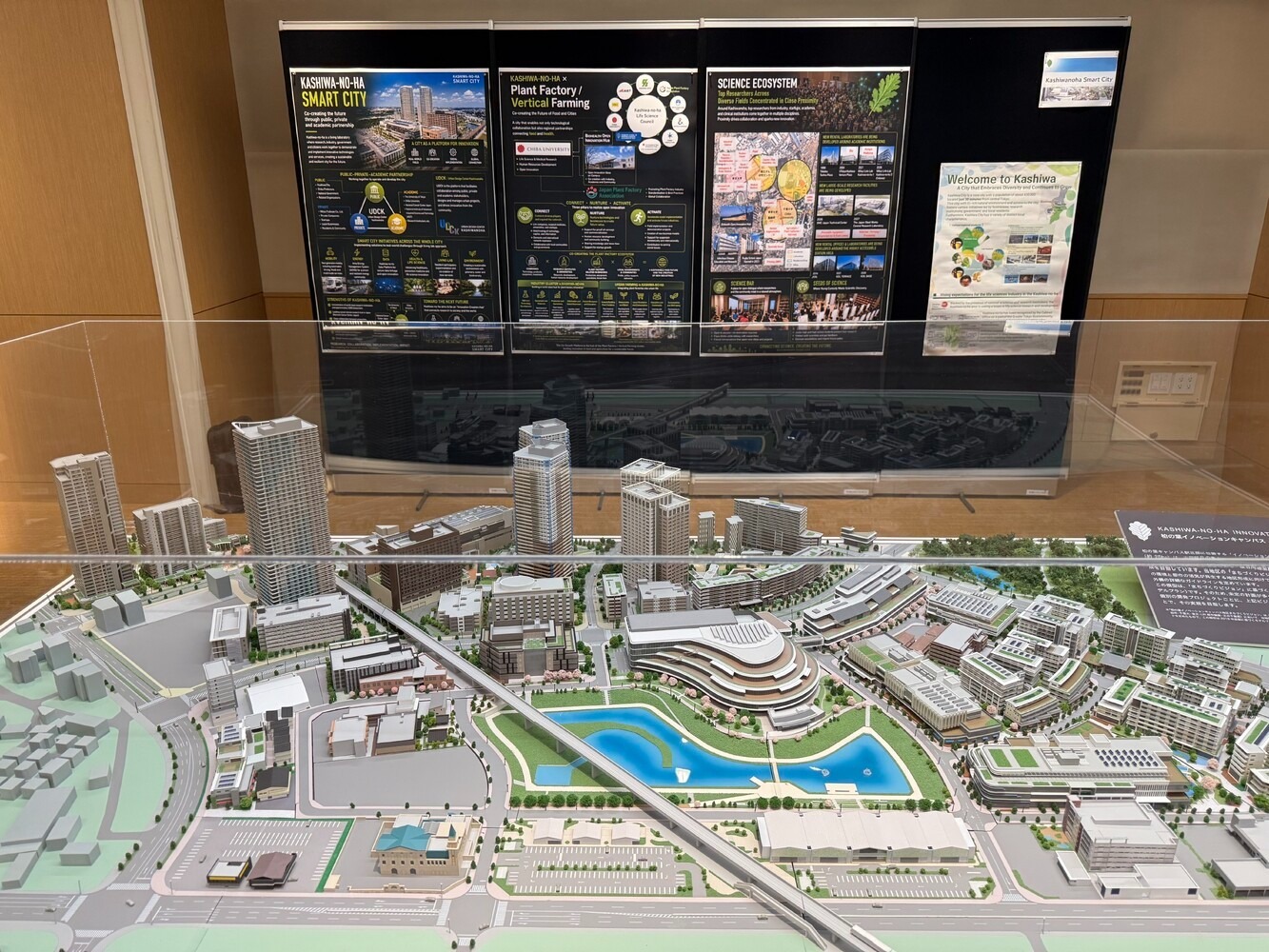
That governance model needs scale, and Kashiwanoha Smart City is where it's actually running, a more exportable model than any single crop recipe. Chiba Prefecture, Kashiwa City, the University of Tokyo, Chiba University, and developers led by Mitsui Fudosan built it together across 273 hectares, betting on three goals at once: an environmentally sound district, a healthier and longer-lived population, and room for new industries to take root. The National Cancer Center Hospital East, two universities, a national research institute, and Mitsui's incubation labs all sit within walking distance of each other under one governance structure. That proximity compresses the timeline: something discovered in a university lab can move into a nearby plant factory, onto a hospital tray next door, and through clinical validation in months rather than the decade or more it would normally take.
American cities have the density; what's missing is a governance layer connecting a farm to a hospital's budget on purpose. Houston's Texas Medical Center, the world's largest medical complex, packs 54 institutions, 21 hospitals, four medical schools and Rice University onto 2.1 square miles, employing over 106,000 people and handling nearly 10 million patient encounters a year. Nicknamed the "Medical Mini-City," it already has the density Kashiwanoha is built around. What it doesn't have is a plant factory wired into it.
Rochester, Minnesota, is the closer analog: a deliberate district, not an accretion of institutions. Destination Medical Center is a 20-year, $5.6 billion public-private initiative, Minnesota's largest economic development plan, built around Mayo Clinic's own $3.5 billion investment and organized into eight districts including dedicated health, research and innovation zones. It already has the governance, capital and appetite for the kind of pilot Kashiwanoha is proving out. Neither city needs to match Kashiwanoha's scale to take the lesson, only its willingness to put a farm and a hospital under one plan.
What This Means If You're Planning the Building, Not the Crop
None of this requires a hospital system or a city to start from theory. Agritecture has already designed a plant factory into a special needs school, shaped urban agriculture recommendations for St. Jude Children's Research Hospital, and built greenhouse masterplans directly into hospital campuses in the Middle East, the kind of feasibility and masterplanning work this piece draws on. The pattern across all of it holds: the systems that work are the ones designed in from the start, not added on after the fact.
That timing is the real decision for a hospital system, or a developer building near one. Bring a plant factory or greenhouse into the site plan while HVAC, water, and floor loads are still on paper, and it becomes part of the building's infrastructure. Wait for the food service contract to come up for renewal instead, and it becomes a vendor swap that nobody who stands to benefit from it has the authority to approve.
Cities face a version of the same choice, one level up. A Kashiwanoha-style health district doesn't happen because a plant factory gets built somewhere nearby. It happens because urban agriculture strategy and food policy work ties that growing system to the health system on purpose, while both are still being planned.
Building the farm is the straightforward part. Deciding which system it plugs into, and who ultimately pays for what it delivers, is what determines whether it functions as infrastructure or sits as an amenity. Agritecture Designer exists to work through that case before the first shovel goes in.