
Jun 15, 2026
The novel CEA industry faces ongoing critical financial scrutiny following continued high-profile operational failures, revealing essential lessons for investors, developers, and entrepreneurs in vertical farming ventures.
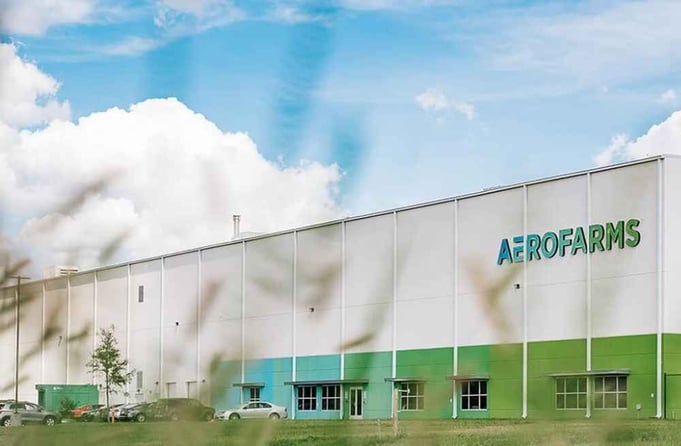
AeroFarms vertical farm in Virginia. Image courtesy of AeroFarms.
What the AeroFarms Collapse Reveals About CEA Industry Vulnerabilities
Well, if this isn't the bottom of the vertical farming trough of disillusionment, I don't know what is. The April 2026 acquisition of AeroFarms by Palm Ventures that has only recently become public represents more than a corporate transaction—it crystallizes the structural vulnerabilities that have plagued vertical farming investment over the past five years. When AeroForms agreed to a SPAC merger in March 2021 at a $1.2 billion pro-forma equity value, projecting $330 million in revenue and 16 operational farms by 2025, the deal embodied the sector's peak optimism. The reality that unfolded tells a categorically different story: a Chapter 11 bankruptcy in 2023, consolidation to a single 140,000-square-foot Virginia facility, repeated closure notices to state officials, and ultimately a balance-sheet rescue to clear debt obligations.
This trajectory exposes a fundamental misalignment between capital deployment strategies and operational realities in CEA ventures. Vertical farms were systematically financed using software company valuation multiples while operating with the cost structures of capital-intensive food manufacturing facilities. Software businesses invest upfront in product development and subsequently distribute at near-zero marginal cost. Vertical farms require substantial capital expenditure for facility construction, followed by continuous daily operating expenses for energy, labor, food safety compliance, and distribution of perishable products through conventional retail channels. The former scales through code and microchip efficiencies; the latter scales through physical infrastructure replication with compounding operational complexity.
.png?width=1920&height=300&name=Blog%20CTA%20Banners%20(4).png)
The AeroFarms case demonstrates how this structural mismatch creates investment risk that traditional due diligence frameworks failed to adequately capture. Investors approaching CEA ventures with technology sector assumptions systematically underestimated working capital requirements, energy cost volatility, labor intensity, and the operational discipline required for consistent food safety compliance. These vulnerabilities were further compounded by overoptimistic revenue projections that failed to account for market penetration timelines, retail distribution challenges, and price premium sustainability in competitive fresh produce markets.
For investors deploying capital into CEA projects today, the AeroFarms transaction provides the most instructive data point of the current market cycle; not as a reason to avoid the sector, but as a framework for identifying which operational and financial characteristics differentiate viable projects from those destined for similar restructuring.
Financial Modeling Gaps That Lead to Facility Failures
The collapse of high-profile CEA ventures stems from systematic financial modeling errors that obscured true unit economics and capital efficiency metrics. Most failed projects relied on revenue projections that assumed rapid market acceptance of price premiums without adequate validation of consumer willingness to pay or retailer margin requirements. These models frequently projected facility utilization rates exceeding 85% within 18-24 months of operation, despite industry data demonstrating that achieving consistent production at target yields requires 36-48 months of iterative crop management refinement. The gap between projected and actual revenue timelines created cash flow shortfalls that exhausted working capital reserves before operations reached sustainable profitability.
Energy cost modeling represented another critical vulnerability. Many feasibility studies utilized static electricity rate assumptions or relied on optimistic projections for renewable energy integration that failed to materialize at projected costs. In reality, vertical farms operate as continuous industrial facilities with energy consumption representing 25-35% of operating expenses. A 20% variance in energy costs; whether from rate structure changes, demand charge impacts, or renewable energy delays; can eliminate projected operating margins entirely. Projects financed without adequate stress testing for energy cost volatility or without contractual mechanisms to manage rate exposure faced structural profitability challenges regardless of operational execution quality.
Labor productivity assumptions frequently diverged from operational reality by factors of 40-60%. Financial models often projected labor requirements based on theoretical automation capabilities rather than actual labor intensity required for crop management, quality control, harvesting, packaging, and food safety compliance. Projects that modeled eight full-time equivalents per acre of production space routinely required 12-15 FTEs to maintain production schedules and quality standards. This labor intensity gap created permanent structural cost disadvantages that could not be resolved through operational optimization alone. Facilities designed around unrealistic labor assumptions lacked the physical layout, workflow design, and automation infrastructure to subsequently improve productivity without fundamental capital reinvestment.
The most consequential modeling gap involved inadequate contingency reserves for equipment replacement, technology iteration, and crop diversification. Business plans typically allocated 3-5% of capital expenditure for contingencies, yet operational experience demonstrates that 15-20% contingency reserves better reflect the technical risk profile of CEA facilities. Environmental control system failures, lighting system degradation, irrigation equipment replacement, and food safety infrastructure upgrades represent predictable capital requirements that many projects failed to adequately reserve for in initial capitalization. Projects that entered operations undercapitalized for these foreseeable technical requirements faced binary choices: seek additional equity dilution, compromise operational standards, or face facility closure.
Technology-Agnostic Due Diligence for Investment Decision-Making
Effective CEA investment due diligence requires a technology-agnostic analytical framework that evaluates projects based on fundamental operational and market viability rather than proprietary technology narratives. The sector's highest-profile failures shared a common characteristic: investment theses constructed around proprietary growing systems or automation technologies rather than demonstrated unit economics and market access. Technology differentiation matters only to the extent it creates measurable advantages in yield consistency, input efficiency, labor productivity, or food safety performance that translate into sustainable cost advantages or revenue premiums. Due diligence frameworks must therefore prioritize validation of operational performance metrics over evaluation of technology novelty.
 A rigorous technology-agnostic approach starts with independently verifying yield claims under real commercial conditions, not controlled trials. Investors should see multi-cycle data on achieved yields per square foot, losses, quality downgrades, and pack-out rates for premium versus secondary product. Headline capacity figures (for example, 500,000 pounds per year) are meaningless without this evidence. Projects that cannot or will not provide granular production data from existing facilities represent elevated risk, regardless of technology sophistication.
Market access validation is the second critical component of technology-agnostic due diligence. Investors must independently confirm that real customers will buy at the projected prices and volumes through direct conversations with retail, food service, and direct-to-consumer partners. Letters of intent or MOUs have limited value without evidence that similar products already move through the buyer’s supply chain; visiting operational facilities and observing loading dock activity remains the most reliable proof of functioning commercial relationships.
Financial model stress testing is the third pillar of effective due diligence. Rather than accepting base case projections, investors should require sensitivity analyses that test scenarios such as longer timelines to target yields, higher energy and labor costs, and lower realized prices. Projects that remain viable under these stressed assumptions demonstrate true financial resilience; those that fail under modest adverse conditions lack sufficient margin of safety, regardless of technology. This shifts evaluation from optimistic projections to downside protection—the discipline that separates durable investments from speculative bets.
Operational Efficiency Metrics Every Investor Should Monitor
Investors in CEA ventures should monitor leading operational metrics, not just revenue and gross margin, to detect issues early and protect viability. The most important indicators are:
-
Production consistency: Track harvested yield per square foot versus target for every cycle, the share of cycles hitting target, and yield trends. Volatility above ~15% or yields below ~80% of target signal structural growing or control problems that require immediate intervention.
-
Input efficiency: Monitor energy per pound produced, water use, and media/nutrient costs as a share of revenue. Consumption more than ~10% above modeled levels points to equipment inefficiency, environmental control issues, or poor design. Continuous efficiency gains indicate operational discipline; deterioration suggests deferred maintenance or process drift.
-
Labor productivity: Measure pounds harvested per labor hour (by activity: growing, harvesting, packaging, food safety). Labor typically represents 20–30% of operating costs, so worsening pounds per FTE over time flags workflow, automation, or complexity issues; steady improvement indicates effective learning and optimization.
-
Working capital health: Track days of inventory, days sales outstanding, and cash conversion cycle. Fresh produce operations should turn inventory more than 50 times per year and collect receivables within 30–45 days. Rising inventory, slower collections, or higher-than-planned working capital use signal quality, credit, or demand challenges and require rapid corrective action.
Building Resilient CEA Projects Through Data-Driven Planning
Many of you are considering planning a CEA facility so I want to share some thoughts for those planning new farms. Developing resilient CEA projects, whether vertical farming or greenhouse, requires integration of comprehensive data analysis throughout the planning process, from initial feasibility assessment through facility design and operational planning.
The industry's highest-performing facilities share common characteristics: planning processes grounded in validated local market data, realistic technology performance benchmarks, and conservative financial assumptions that create meaningful margin of safety.
This data-driven approach contrasts sharply with the optimistic technology narratives and aspirational projections that characterized failed ventures. Investors and developers who prioritize evidence-based planning over visionary narratives systematically achieve superior risk-adjusted returns.
Effective market analysis starts with detailed, local assessment of demand, competition, and distribution. Resilient projects rely on primary research—direct conversations with retailers, food service operators, and institutional buyers—to confirm workable price points, volumes, delivery terms, and food safety requirements. Securing binding supply agreements with creditworthy buyers before construction is the strongest form of market validation; projects built on assumed demand instead of confirmed contracts carry significantly higher risk.
Technology selection should be based on validated performance from comparable commercial facilities, not theoretical specs or small pilots. Developers should benchmark multiple operating sites for yields, quality consistency, reliability, maintenance needs, and true operating costs. Choosing equipment on marketing claims alone creates substantial execution risk; the most successful projects favor proven technologies with multiple commercial references, even if that means accepting slightly lower theoretical performance in exchange for much lower technical risk.
.png?width=1920&height=300&name=Blog%20CTA%20Banners%20(7).png)
Resilient financial planning relies on scenario analysis, not single-point forecasts. Projects should model base, conservative, and stress cases with matching capital requirements, and be capitalized to remain viable under the conservative case, with stress scenarios defining contingency reserves. Developments funded only for the base case lack resilience and are far more likely to require emergency capital or restructuring when normal challenges arise; as the AeroFarms outcome demonstrates.