
Jun 23, 2026
The same grow lights, root zones, and climate controls keeping World Cup pitches alive under a roof are the foundation of CEA. Here's what the industry should take from it.
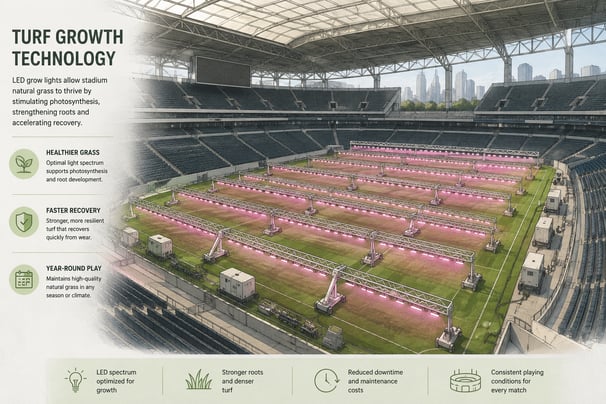
AI-generated illustration
FIFA has spent five years and over $5 million engineering natural grass to survive inside domed NFL stadiums for the 2026 World Cup, deploying retractable LED grow lights, engineered root zones, and climate controls that look identical to what indoor farms have been refining for a decade. The detail worth noticing isn't the grass. It's that the world just ran a large-scale, highly visible proof-of-concept for controlled environment plant science, inside a mainstream real estate asset, in front of an audience of billions, and almost no one in the audience recognized it for what it was.
The pitch as a growing system
As the 2026 World Cup kicked off across 16 stadiums in the United States, Canada, and Mexico, the surface under the players' boots is the product of one of the largest turfgrass research programs ever assembled. FIFA commissioned John Sorochan at the University of Tennessee and Trey Rogers at Michigan State University, the same pairing that handled the 1994 World Cup at Detroit's Pontiac Silverdome, to lead a five-year research and development project launched in 2022, when host venues were confirmed. The program brought together more than 200 turf specialists from all 16 host stadiums for joint research field days, the first time pitch managers across an entire World Cup cycle coordinated at this scale.
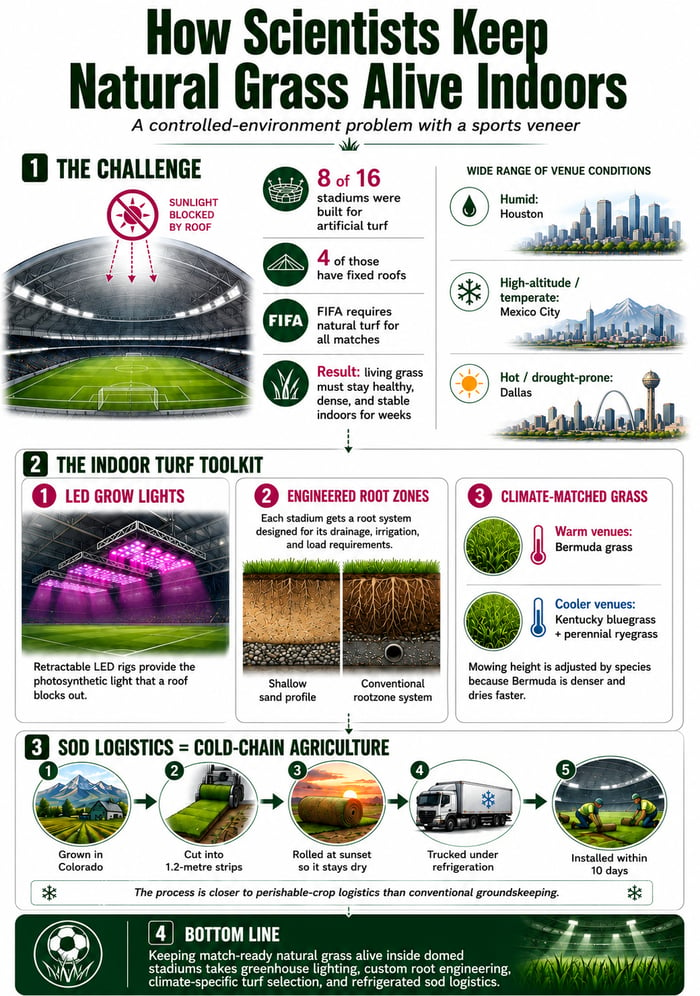
The problem the scientists were solving is, at its core, a controlled environment agriculture problem in a sports uniform. Eight of the sixteen stadiums are built for artificial turf because they normally host NFL teams. Four of those have retractable roofs, meaning the grass inside will never see direct sunlight once it is installed. FIFA requires natural turf across all World Cup matches, so something has to keep living grass alive, dense, and structurally sound under a dome for weeks, across stadiums spanning three countries and climates ranging from the humid heat of Houston and Miami to the cooler, high-altitude conditions of Mexico City and Toronto.
AI-generated illustration
The solution reads like a greenhouse operator's checklist. Retractable LED grow light rigs, the kind that bathe a domed pitch in a magenta glow, replace the sunlight a closed roof cuts off. Root zones are engineered specifically for each stadium's drainage, irrigation, and load requirements, with some venues using a shallow sand profile and others a conventional system, depending on what sits beneath the pitch. Grass species are matched to local climate: Bermuda grass for warm-weather venues, a Kentucky bluegrass and perennial ryegrass blend for cooler cities, with mowing height adjusted by species because Bermuda is denser and dries faster. Sod grown in Colorado is cut into 1.2-metre strips, rolled at sunset so it stays dry, and trucked under refrigeration to arrive at each stadium within ten days, a process closer to cold-chain food logistics than anything in conventional groundskeeping.
.jpg?width=1920&height=300&name=Blog%20CTA%20Banners%20(1).jpg)
One playbook, two industries
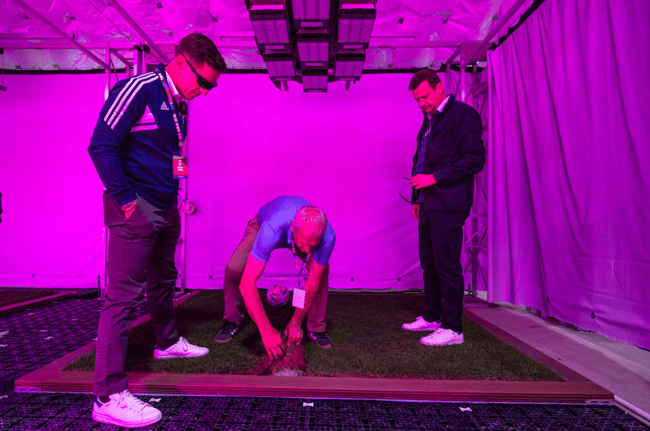
Researchers examining turf samples under LED grow lights at research facility. Credit: University of Tennessee
Strip away the football and the parallel is hard to miss. An LED rig calibrated to keep grass alive under a closed roof and an LED system tuned to push yield in a commercial greenhouse are answering the same question: how much light does this plant need, at what spectrum, on what daily schedule, to stay healthy without the sun? The root zones FIFA's engineers built to manage drainage are the same substrate design challenge CEA engineers face when specifying growing media for a hydroponic or aquaponic system. The irrigation, drainage, and ventilation infrastructure retrofitted into domed stadiums that were never designed for living plants is the same set of building integration problems any architect or developer encounters when adding a farm to a structure that wasn't designed for one.
The expertise, the equipment specifications, and the operating data now sitting inside two university turfgrass programs represent a knowledge base that CEA operators, architects, and developers can draw on directly. The science has been stress-tested at a scale and under a scrutiny that few agricultural projects ever attract. That is worth paying attention to.
A lesson for urban agriculture and the built environment
The World Cup offers something more useful than a cautionary tale. It offers a blueprint.
Cities are building upward. Mixed-use towers, transit hubs, covered markets, and urban districts are being designed and constructed every day, and in most cases, the integration of food production into the built environment is treated as an afterthought, something bolted on after the core design is locked. What FIFA's researchers discovered, at considerable expense and under enormous public pressure, is that living plants cannot be bolted on. They need light access, drainage, airflow, substrate depth, and microclimate management built into the structure from the start. When those conditions aren't there, you spend years and millions of dollars trying to engineer them in retroactively.
That is the real invitation for architects, masterplanners, and urban agriculture practitioners. Not "put a farm in your stadium," but rather: every building that aspires to integrate living systems, whether a rooftop greenhouse, an agrihood, a food-producing amenity in a mixed-use development, or an urban farm embedded in a transit corridor, is subject to the same biological constraints FIFA had to solve under its roof. Sunlight is only one of them. Drainage, root-zone depth, climate zoning, and the structural load of a living growing system all matter equally. A building designed without those considerations makes the agriculture expensive, underperforming, or outright impossible.
The urban agriculture community has known this for years. What the World Cup adds is a language that resonates beyond the industry. When a developer, a city planner, or a real estate investor asks why agriculture in buildings requires specialist input from the earliest design stage, the answer now has a reference point most people in the room have already watched on television.

What it means if you invest in or operate a farm
The investment FIFA made was justified by the stakes of a global event, not by a commercial return on the grass itself. The significance for CEA operators and investors is different: it is a high-visibility, institutionally credible validation of the same grow-light technology, substrate engineering, and climate-zone management that indoor food production depends on. That validation happened outside the CEA industry's own
bubble, on one of the most-watched stages in sport. A planning team, a city official, or a cautious lender who has never engaged with a vertical farming pitch deck has now, without knowing it, watched the underlying science perform at full scale. According to Alan Ferguson, FIFA's senior pitch management manager, over $5 million went into that research. As a proof point for the viability of controlled environment plant science, it is one worth using.
Ready to apply these insights to your next CEA project?
We’ve advised on more than $1 billion in agrifood projects across 65+ countries, and our workshops and Agritecture Designer software are built to help you move from concept to fundable plan with confidence.