
Apr 9, 2026
Written by Davi Souza, Space Farming and AgTech Specialist and Consultant
LinkedIn: https://www.linkedin.com/in/daviafs/
As humanity returns to the Moon through the Artemis II mission, we are witnessing a historic milestone, not only in technological advancement but also in the foundational systems that will sustain life off-Earth. Humans’ next steps in space will be even bolder, extending far beyond exploration. It will center on establishing a sustained human presence and, ultimately, transforming the Moon into a prosperous economic hub. As with every major step in human history, one essential capability will accompany us in this journey: Agriculture.

Source: Artemis II crew | NASA
From Exploration to Sustainable Presence
The global space industry is entering a new phase of economic growth and strategic importance. According to the World Economic Forum, the space economy is projected to reach $1.8 trillion by 2035, driven by both space-based and space-enabled technologies. Within this broader context, the industry’s focus is now shifting decisively toward the Moon, where the foundations of a new operational and economic paradigm are being established. The emerging lunar economy alone is expected to exceed $170 billion by 2040, signaling a clear transition from exploration-driven missions to sustained human presence and economic utilization. This shift is being supported by initiatives led by NASA, including a recently announced $30 billion investment in Moon Base infrastructure through 2036.
Experience from the International Space Station (ISS) has already demonstrated that long-duration human presence in low Earth orbit (LEO) is possible. Over the past decades, the ISS has hosted hundreds of astronauts and served as a critical scientific platform for expanding our understanding of space and exploring how life can endure and thrive in a hostile and extreme environment, without atmosphere or gravity. Alternatively, the transition from LEO to the lunar surface introduces a fundamentally different challenge. The current efforts prioritize continuous operations and economic activities on the lunar surface, which involve frequent crewed missions, reusable systems, and the gradual development of permanent, habitable infrastructure. This evolution goes beyond engineering complexity. It demands a shift toward long-term, Earth-independent operations, where sustainability is no longer optional, but essential.
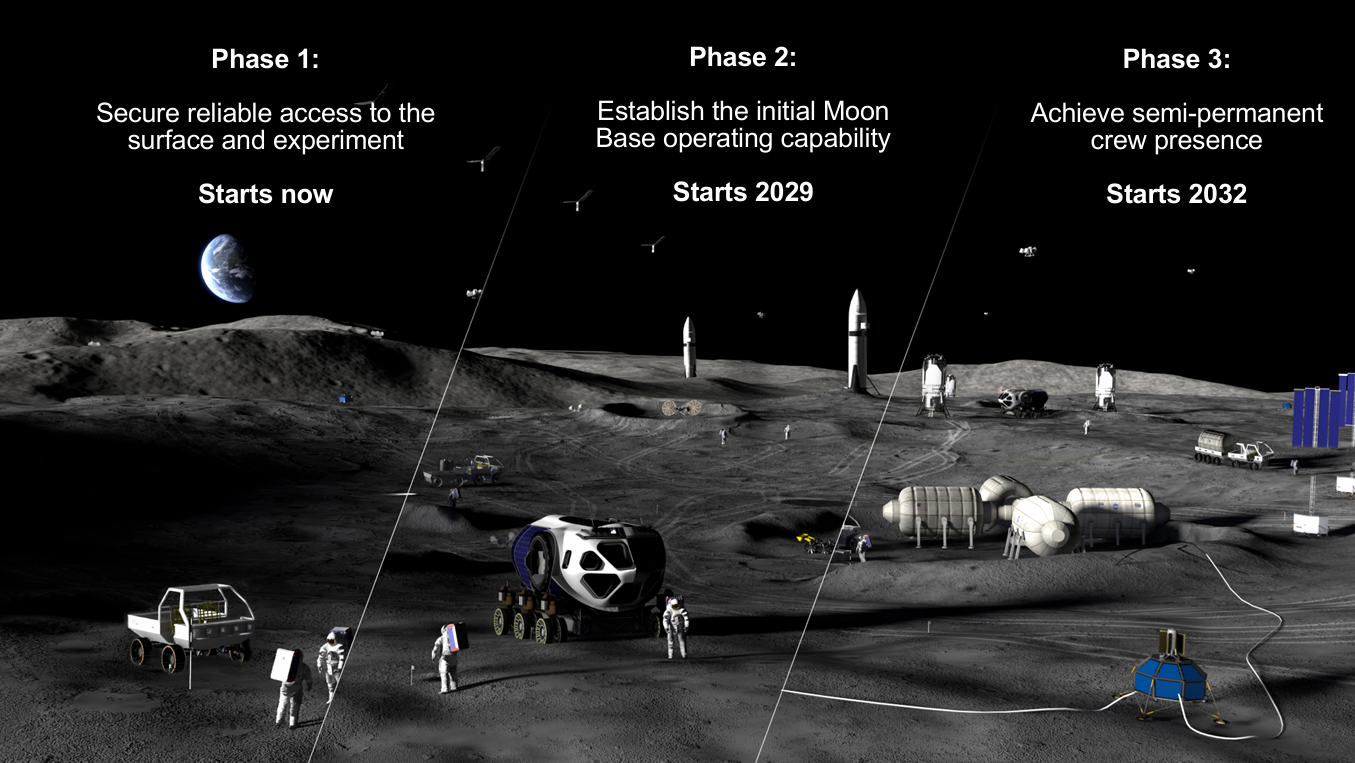
Source: Moon Base evolution concept by NASA
SpaceAg as part of Lunar Infrastructure
Existing mission architectures rely on Earth-dependent supply chains. In terms of food, on the ISS, resupply ranges from 1.83 kg to 2.39 kg per crew member per day. While LEO allows for regular resupply and occasional access to fresh food, short-term lunar missions, such as Artemis II, depend on pre-packaged, fixed menus. This approach imposes limitations on the overall food experience, such as reduced freshness and limited dietary diversity. More critically, this model is neither scalable nor sustainable for extended lunar operations. As missions progress toward increased crew presence, both logistical and economic constraints become increasingly significant. Addressing this challenge requires a fundamental shift: Space Agriculture (SpaceAg) must no longer be treated solely as a science payload, but rather as an integral component of broader lunar infrastructure.
In this regard, in-situ food production offers a fundamentally different model. By enabling continuous access to fresh, nutrient-rich food, SpaceAg systems can provide more diverse and enjoyable meal options, while also improving crew well-being. At the same time, these systems must meet strict technical and economic constraints. Every kilogram delivered to the lunar surface carries significant cost, requiring each component to demonstrate its operational value. This is where regenerative, closed-loop systems become critical. Designed to minimize resource inputs while maximizing output efficiency, these systems simplify mission logistics, reduce dependence on resupply missions, enhance operational autonomy, and directly lower mission costs. When embedded into lunar infrastructure from the outset, SpaceAg transitions from experimental technology to a key enabler of sustainable, scalable, and human-centered lunar operations.
Agri-Food-Tech Systems for Earth and Space
Whether on Earth or in space, agri-food-tech systems operate at the intersection of human sustenance, autonomy, and sustainability. In the context of human spaceflight, they represent a critical step toward enabling a resilient lunar economy, while also unlocking new commercial and technological opportunities. Their deployment, however, requires rigorous testing and validation, seamless integration with habitat and life support systems, and efficient operations within constraints on mass, volume, energy, water, crew time, and cost.
Terrestrial demonstrations are already playing a crucial role in advancing SpaceAg readiness for the Moon. Projects such as EDEN ISS, an Antarctic greenhouse module developed by the German Aerospace Center (DLR), and its successor, EDEN LUNA, are establishing scalable food-production solutions for extreme environments on Earth and lunar operations. Similarly, the BioPod module by Interstellar Lab, originally designed for lunar and Martian applications, is now being used to produce plant-based ingredients for cosmetics products on Earth, illustrating the dual-use potential of SpaceAg innovations.
- DLR’S Greenhouse Module
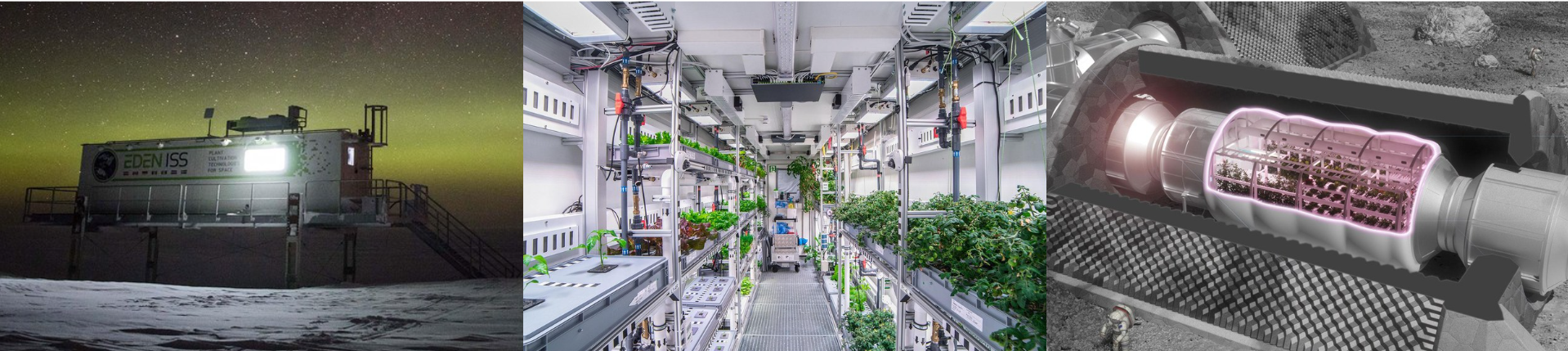
Source: The German Aerospace Center (DLR)
- Interstellar Lab’s BioPod
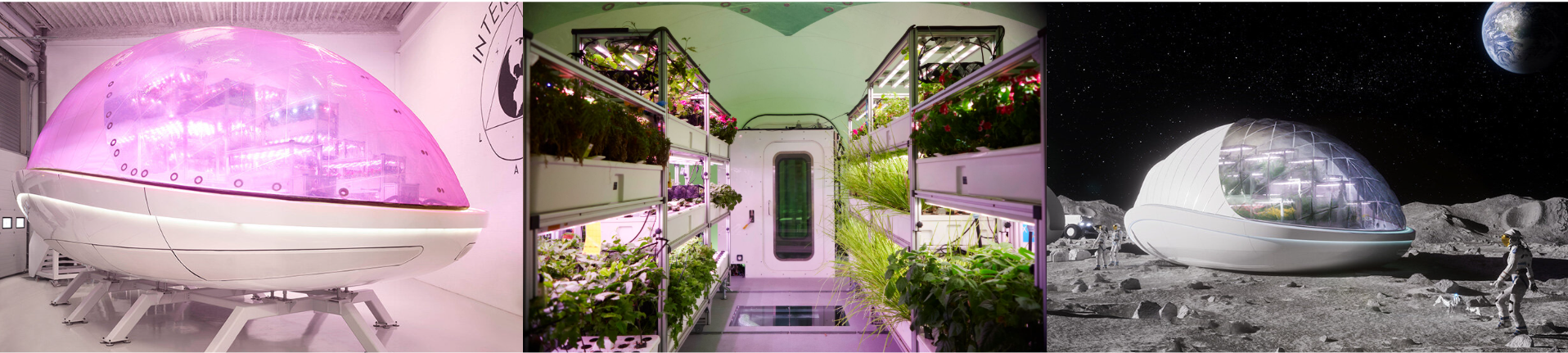
Source: Interstellar Lab via designboom.com
These systems represent early models of agri-food-tech for off-world environments. However, achieving this level of maturity requires sustained investment, continuous iteration, and cross-sector collaboration. A similar transition is occurring within terrestrial controlled environment agriculture (CEA), particularly in vertical farming. While these systems offer strong sustainability benefits, they continue to face significant economic challenges. High operational costs and scalability limitations underscore a critical reality: sustainability alone is not sufficient, and economic viability is essential. Across both terrestrial and space contexts, agri-food-tech systems must deliver clear, measurable value, aligning technological capability with user needs, market dynamics, and operational constraints. This convergence points to a shared vision where space-driven technologies improve agriculture on Earth, and terrestrial advancements support commercialization pathways for SpaceAg infrastructures.
Conclusion: Building the Foundation for the SpaceAg Industry
As the lunar economy takes shape, SpaceAg will play a foundational role. More than a supporting function, it represents a critical infrastructure that directly impacts sustainability, autonomy, and the overall success of future missions. For those interested in exploring this field further, the Space Farming 101 (SF101) is an online course designed to provide a comprehensive introduction to agri-food-tech systems for Earth and Space. SF101 is available on Agritecture Designer: https://design.agritecture.com/premium-courses-public