
Aug 7, 2026
80 Acres Farms just shut down. Here is what a decade of vertical farming collapses actually has in common and the way ahead.

Source: Agritecture
Homer's Odyssey is the oldest story we have about a voyage that runs longer, costs more, and ends smaller than the ambition that launched it. Vertical farming has been living a version of that story for a decade, and this week the fleet lost another ship.
80 Acres Farms announced Monday it is winding down: eleven years in business, more than $350 million raised, roughly 300 jobs in the Cincinnati area alone. It was the last large, venture-backed vertical farm in the U.S. still chasing the industry's original promise, everyday produce for the supermarket aisle.
The technology behind it worked, the same way the technology has worked at nearly every well-funded vertical farm that has since gone under. What sank these companies, one after another, was never the farming. It was the financing, and the mistake was structural, repeated across the industry, not a failure specific to any one team.
A Fleet, Not a Single Wreck
80 Acres joins a list. Fifth Season closed in 2022. InFarm and Kalera both went bankrupt in 2023. Bowery, once valued above $2 billion, shut down almost without warning in 2024.
Plenty filed Chapter 11 in 2025 and came out the other side much smaller. AeroFarms restructured, then spent the winter and spring on a string of short-term lifelines while working with a potential buyer, a deal that closed this spring. In the UK, GrowUp raised £140 million over its lifetime and was sold out of administration in December for £1.85 million.
Every one of these got its own headline explanation at the time. The pattern underneath is consistent: our own Global CEA Census shows vertical farms burning roughly seven times the energy per unit of greens that greenhouses use, with capital costs running more than six times higher per square meter. Shoppers will not pay double for salad indefinitely, no matter how well the farm behind it is run.
Three Things Venture Capital Assumed Vertical Farming Could Do
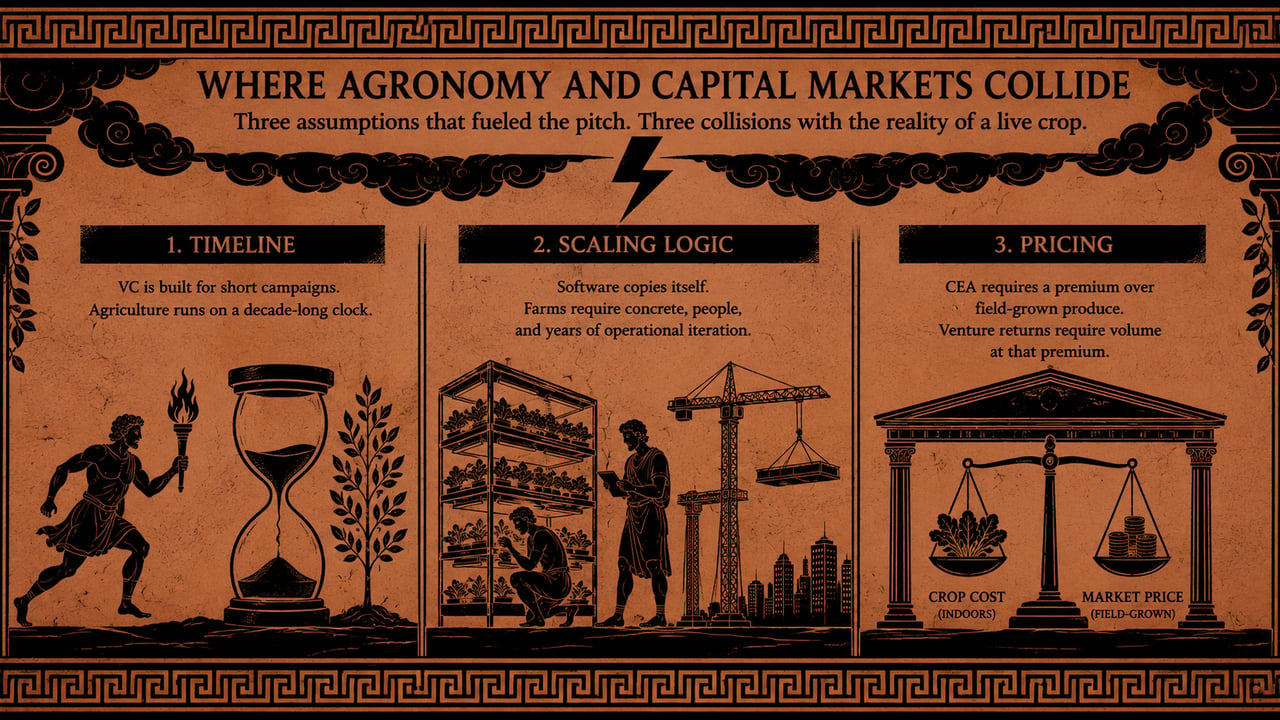
This is where agronomy and capital markets collide, and it is worth naming plainly rather than only through metaphor. Vertical farming's early pitch, farms in skyscrapers, no weather risk, no seasons, software eating agriculture, was never really a farming pitch. It was a technology pitch, and it raised money accordingly, on three assumptions that don't hold for a live crop.
The first was timeline. Venture capital is built for short campaigns: raise, grow fast, exit inside a fund's life. Agriculture runs on a decade-long clock, and by mid-2025, venture investment in indoor farming had fallen to roughly $57 million across five deals, a fraction of its peak, per PitchBook data reported by the Wall Street Journal, evidence that the market itself recognized the mismatch.
The second was scaling logic. Software gets cheaper to scale because it copies itself. A vertical farm scales by pouring concrete, building operations teams capable of running something genuinely complex, and grinding through trial and error until the system runs efficiently. Roughly half the operators surveyed in our Census had never farmed before starting their companies, a crew assembled to tell a growth story more than to run a farm.
The third was pricing. Vertical farming economics require a premium over field-grown produce to cover the energy and capital cost of growing indoors. Venture-scale returns require volume at that premium, at commodity crops, in a market that has consistently refused to pay it.
This summer, lettuce was recalled across 27 states over suspected contamination, pulled from shelves, at the same moment a company growing produce sealed off from exactly that risk was shutting down and discarding its last harvest. Demand for the product was never the problem. The math around financing it was.
What the Evidence at 80 Acres Actually Shows
80 Acres is useful here specifically because it wasn't a story of mismanagement. Agritecture's team toured the company's Florence, Kentucky facility in 2025, a former printing plant converted into a $95 million indoor farm with genuinely best-in-class lighting, climate control, and automation, and a company culture that credited its technology partners openly rather than obscuring them.
In 2025 alone, the company raised $115 million, acquired three of Kalera's farms out of bankruptcy along with Israeli biotech Plantae Biosciences, merged with Soli Organic to build what it called one of the largest indoor farming networks in the world, and took in another $28 million as late as October.
Co-founder Tisha Livingston positioned the company publicly as the industry's consolidator, pointing to individual farms that were already profitable, and co-founder Mike Zelkind later confirmed that framing: the farms made money; the company, carrying the centralized cost of integrating every newly acquired facility at once, didn't yet. That is a hard, honest bet in a capital-starved industry, and it nearly worked. Capital was still arriving nine months before the company had to close.
Zelkind told the New York Times this was "advanced manufacturing, not software," a framing the Times' own reporting backed up, noting that farms and their investors had underestimated what they were entering in an industry where margins are already thin.
We named hype and energy as the industry's two defining problems in a 2022 piece for The Food Institute, and flagged the underlying mismatch as early as December 2021. Energy is a solvable siting and engineering problem.
Hype shaped which pitches got funded: describe a farm honestly and grow slowly, or describe a rocket ship and raise fast. Most of the industry chose the rocket ship. Agriculture eventually chose for everyone anyway.
What Patient Capital Looks Like
Other markets are proving the alternative works. This summer, Japan folded indoor farming into its national growth strategy alongside priorities like AI and aerospace, targeting roughly $28 billion in plant factory investment by 2040.
The plan is candid that about 60 percent of existing plant factories currently lose money, and Tokyo is committing anyway, because after a third consecutive record-hot summer damaged field crops and pushed food prices up at twice the general inflation rate, controlled growing looks less like a luxury and more like infrastructure. A government can plan in decades. A fund cannot.
The same logic is playing out in private capital. Oishii closed the first $150 million of a new round in May, bringing its lifetime total to $370 million, built around premium strawberries priced well above anything commodity salad could support.
In Canada, GoodLeaf Farms raised fresh capital last fall specifically to double output, backed by a major food company, an agricultural lender, and a private equity firm that specializes in agri-food: investors who underwrite farms for a living, not venture funds chasing a growth curve.
Neither model is risk-free. Oishii now carries capital with real expectations attached, and will face its own pressure if it can't diversify beyond premium berries. But the capital source matches the crop's actual margin, which is the piece that kept breaking everywhere else.
Six Kinds of Vertical Farms That Can Work
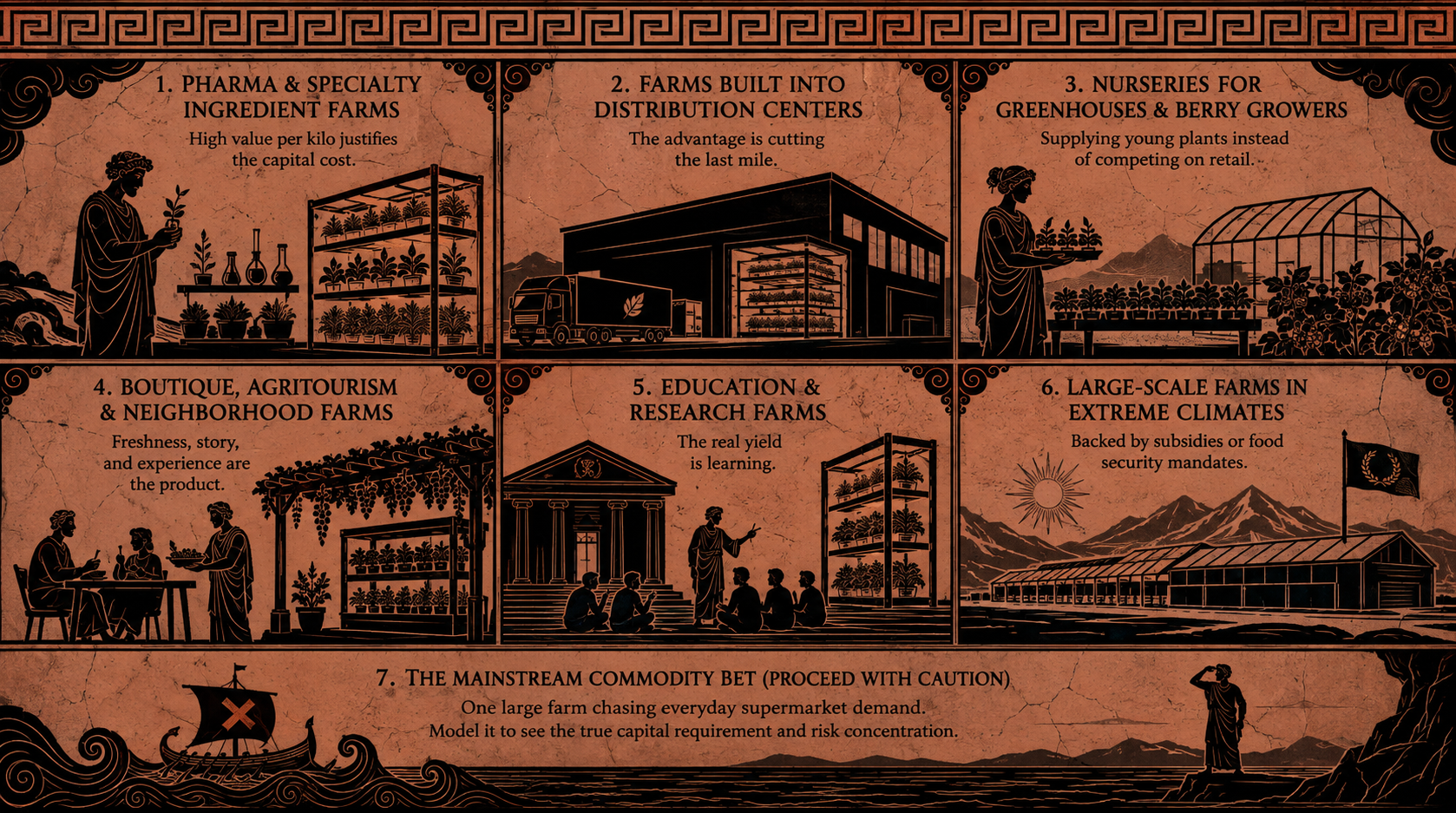
Here is where we think the industry actually goes from here. Six categories keep showing up where the crop, the buyer, and the facility type are matched to each other from the start, instead of assuming a general growth story will scale:
- Pharma and specialty ingredient farms, where the value per kilo is high enough to justify the capital cost.
- Farms funded by and built into food distribution centers, where the advantage is cutting the last mile rather than competing head-on with field-grown produce at retail.
- Farms as nurseries for greenhouses and berry growers, supplying young plants instead of competing on commodity retail pricing.
- Boutique, agritourism, and neighborhood micro farms, where freshness, story, and experience are the actual product.
- Education and research farms, in schools, universities, and test kitchens, where the real yield is the learning.
- Large-scale farms in climates too extreme for greenhouses, backed by subsidies or food security mandates, roughly the model Japan is now backing with public capital.
This list is a working view, and we expect more additions from the industry as new models get built and tested. None of these six are betting on venture-style appreciation to cover a commodity margin, which is the piece that broke everywhere else in this piece. Whatever tools a founder or investor uses to test one of these against real numbers, crop by crop, tariff by tariff, before a design is locked in, that discipline is the actual takeaway, more than any one platform. Agritecture Designer is one option for that kind of modeling. A seventh path, one large farm chasing everyday supermarket demand, is worth modeling too, if only to see clearly how much capital it requires and how much risk that concentrates in a single facility.
The Opportunity
Homer gives his story a next generation. Telemachus never sailed to Troy. He inherits the lessons of that voyage without the pride that caused it.
We think the next wave of CEA companies will benefit the same way, from a decade of hard technical progress, from experienced talent released by the earlier collapses, and from watching closely which assumptions broke the pioneers.
Zelkind's own closing statement gestured at this, describing the 80 Acres team as having planted seeds for future harvests. We think that's exactly right, and it's the note this deserves to end on, not the shutdown itself.
The technology was never the failure point. The financing was, and it is fixable, crop by crop, buyer by buyer, before the concrete is poured rather than after.
.png?width=1280&height=200&name=Blog%20CTA%20Banners%20(4).png)