
Apr 19, 2026
Written by Niko Simos, Business Development Manager, Agritecture
LinkedIn: www.linkedin.com/in/nikos-simos
Every week, someone sends us a business plan for a farm. Sometimes it's a founder with $500K saved up and a warehouse already under lease. Sometimes it's a hotel group imagining a rooftop farm to supply the restaurant. Sometimes it's a city trying to launch a food security program, a developer adding agriculture to a mixed-use tower, or an investor trying to decide whether the deal in front of them is real or fantasy.
The question underneath all of these is the same: Will this actually work?
After 350+ projects across 45 countries, we've learned that "will it work" is never a single answer. It's a stack of five questions, answered in sequence, and the order matters far more than most people realize. We call it the Feasibility Stack. It's the framework our consultants run through before we tell any client to proceed - or to stop.
Here's how it works.
Layer 1: Market Reality
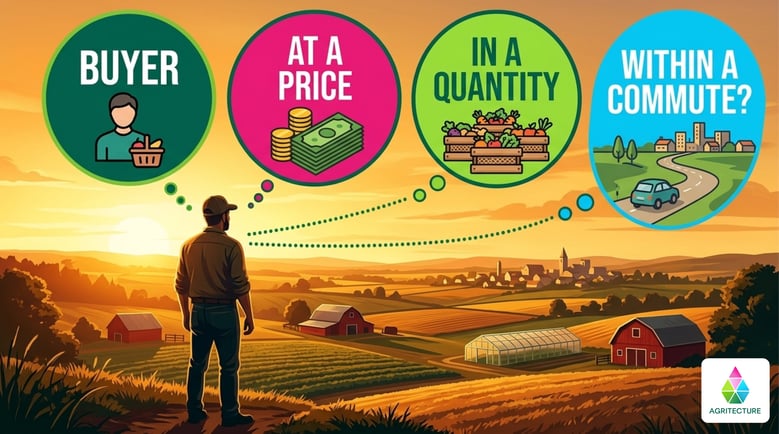
Before anything else, we ask: Is there a buyer, at a price, in a quantity, within a commute?
This sounds obvious. It is almost never done correctly.
Most founders build a market assumption around a retail price they saw on a shelf. But the shelf price is not your price. Your price is the wholesale price the retailer is willing to pay, minus distribution, minus shrinkage, minus your margin. For most leafy greens in most North American markets, that's a wholesale ceiling around $3 to $5 per pound, and retailers will negotiate hard against benchmarks from California field growers.
We have saved clients from disastrous decisions at this layer alone. One project we assessed was modeling $8 per pound basil. Reality, once we ran the interviews with their target distributors, was $3.50. That single correction flipped a "profitable in year three" model into a "never profitable at this scale" verdict. Better to learn it in a $5,000 market study than in a $5 million facility.
Layer 2: Crop + Technology Fit
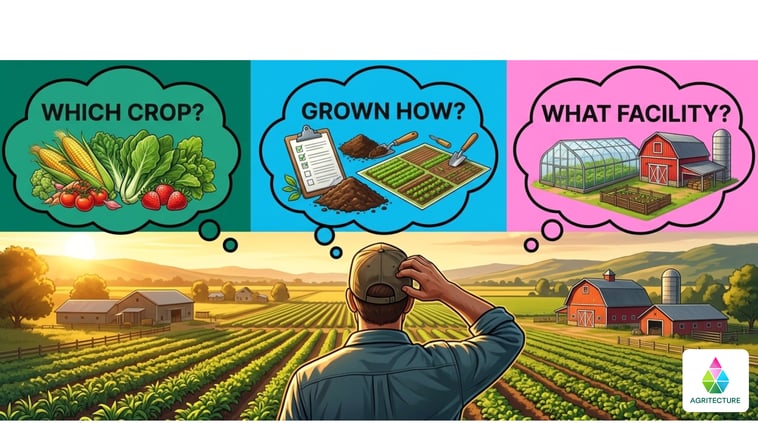
Once the market is real, the next question is: Which crop, grown how, in what kind of facility?
Here's the insight most people miss: crop selection drives everything else. The crop determines the lighting intensity you need, the water chemistry, the climate setpoints, the labor requirements, and the revenue-per-square-foot ceiling. Pick the crop first, and the technology choices follow logically. Pick the technology first, and you will force yourself into crop decisions that don't match the market reality you just validated in Layer 1.
The most common mistake we see: founders who fall in love with a grow system — usually something they saw at a trade show — and then try to back-solve for a crop that fits. It almost never works. The system becomes a beautiful, expensive cage.
Layer 3: Facility + Location
Now, and only now, do you evaluate the site.
At Agritecture, site selection has a 10-point checklist we run for every client engagement.
- Ceiling height and Floor load.
- Power capacity (this is the one that kills warehouse conversions most often).
- Water quality and volume.
- Access to loading.
- Proximity to your market.
- Zoning and regulatory permissions.
- Climate profile — because even "indoor" farms pay for the climate outside the building.
- Labor market.
- Insurance cost.
- Exit optionality.
The two points people most often miss are power capacity headroom for future expansion and labor availability at the wage you actually modeled. Get either of those wrong and the economics quietly collapse in years two and three, long after the build is complete.
Layer 4: The Financial Model
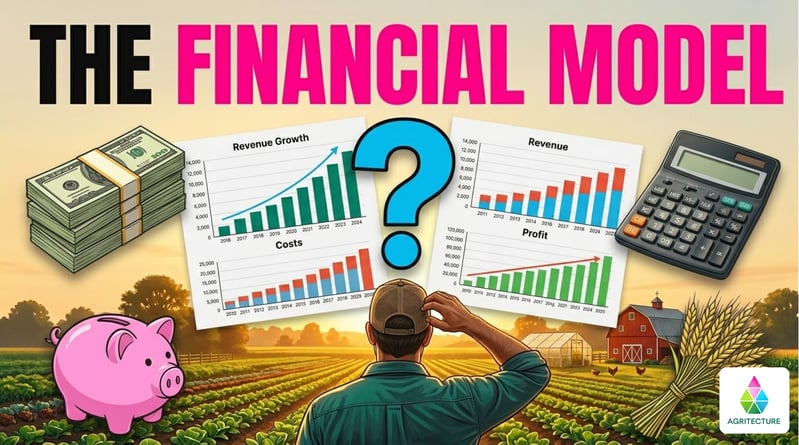
By the time you reach the financial model, you should have real inputs — not assumptions. Real buyer conversations. Real crop yields from pilot data or benchmark farms. Real site quotes. Real labor rates.
A credible CEA financial model has at least 12 line items that most founders underestimate. The ones we see missed most often: commissioning period revenue shortfall, shrinkage and food safety rejection rates, biosecurity downtime, wage inflation over a 5-year horizon, replacement cost for LED fixtures and HVAC components, working capital for inventory and receivables, and the cost of management depth that most first-time founders skip entirely.
Build the model with real inputs, stress-test it against three scenarios (conservative, base case, optimistic), and look at the cash curve — not just the income statement. Farms don't die from unprofitability. They die from running out of cash. Those are different failure modes, and you need to model both.
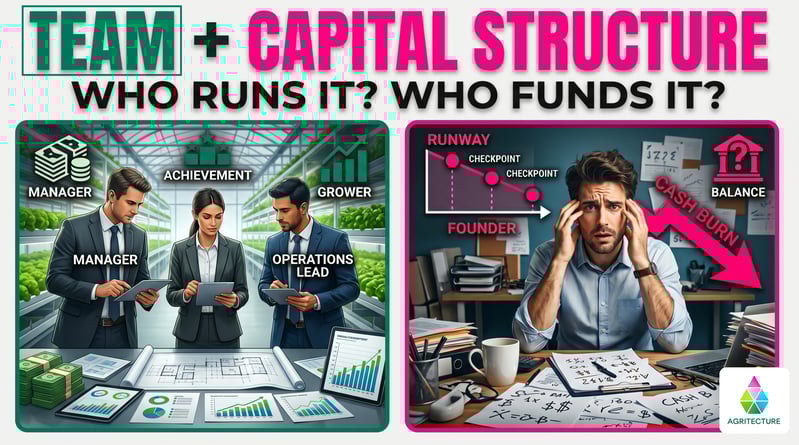
Layer 5: Team + Capital Structure
The final layer is the one most skipped by technical founders and most scrutinized by investors: Who is going to run this, and does the capital plan match the business plan?
A profitable small farm run by a disciplined team will beat a visionary farm with a green CEO every time. We've seen it over and over. The best operators we work with treat farm management as a capability to build, not a box to check. They hire head growers with real operational track records, not just CEA enthusiasts. They budget for a general manager with food manufacturing discipline, because vertical farming, at scale, is food manufacturing.
On capital: raise enough to get to breakeven plus 12 months of runway, not enough to fund your next five facilities. Staged capital with clear milestones beats a single massive raise at an inflated valuation. The farms that have survived the 2022-2025 shakeout almost universally had tighter, more disciplined capital structures than the ones that didn't.
The Point of the Stack
The Feasibility Stack isn't a checklist to complete. It's a conversation to have — honestly — before you commit a dollar of capital. Each layer answers a question that has to be right before the next one matters. Skip a layer, and the work in the layers above becomes invisible risk.
About 40 percent of the projects we assess start out unprofitable in the initial model. That's not a failure of the framework — it's the framework doing its job. We refine them until they work, or we tell the client not to proceed. Both outcomes save capital. Both outcomes protect people from decisions they would regret.
Want to Run Your Project Through the Stack?
The Feasibility Stack is built into the Agritecture Designer platform — our SaaS tool that walks you through farm planning layer by layer, with benchmark data from our global project database behind every calculation. It's how founders, developers, and investors run the first pass on a CEA concept before committing to a full feasibility study.
If your project is at a decision point and you want to stress-test it with our team, a $99 expert call is the highest-leverage 30 minutes you'll spend on this business.
Try Agritecture Designer free →
Know Before You Grow.
We built the framework so you don't have to learn it the expensive way.